What Production Checkout Taught Me About Idempotency
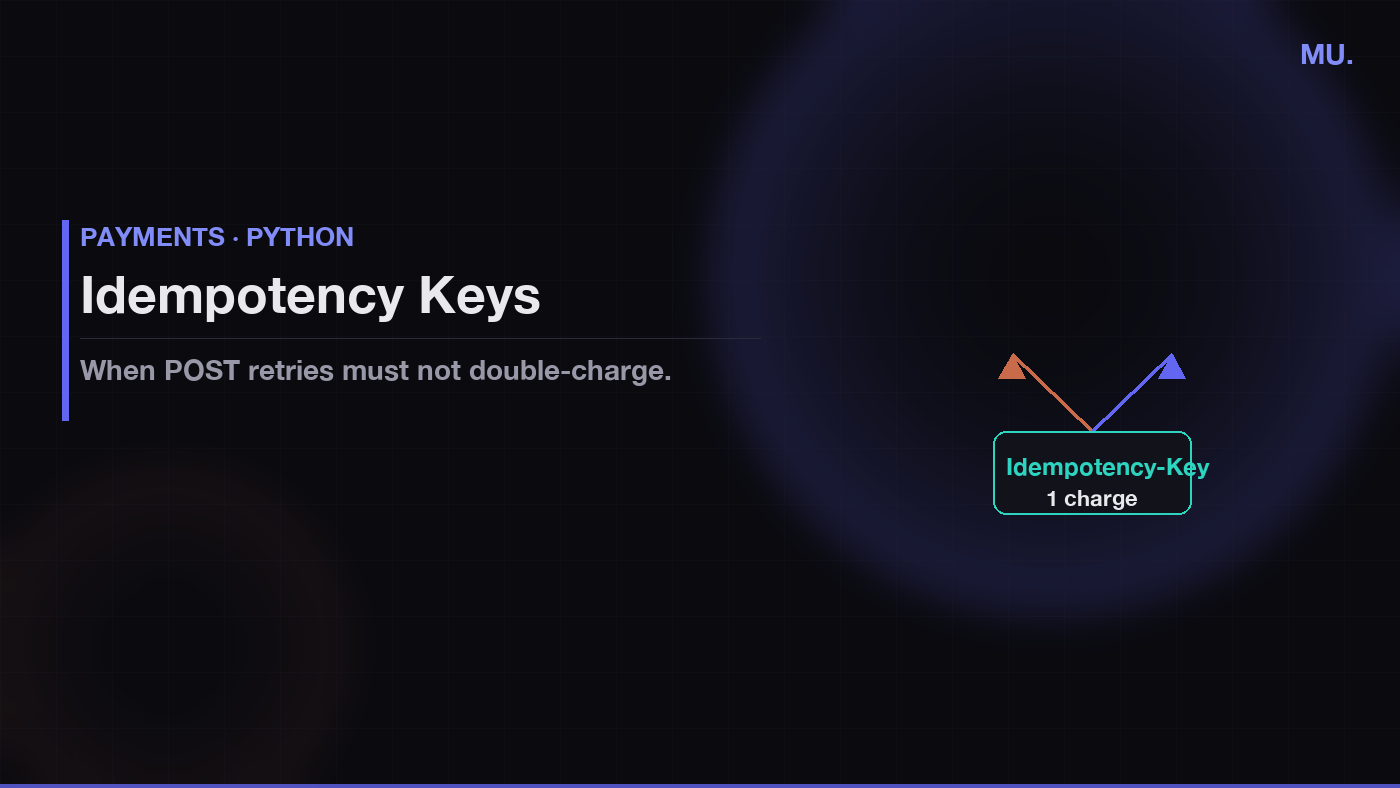
Duplicate charges and "payment succeeded, order failed" are design failures — not bad luck. Here is the architecture that prevents them.
The incident finance remembers
Support tickets with the same pattern: the customer's card was charged, the app showed an error, and someone had to refund manually.
The payment gateway did its job. Your system failed after money moved — or processed the same intent twice because a retry looked like a new request.
These bugs destroy trust faster than downtime. They also separate backend engineers who understand distributed systems from those who only handle happy-path CRUD.
Two failure classes
1. Retry without deduplication
POST creates a new resource on every call unless you design otherwise. Mobile clients retry. Proxies timeout. Users double-tap Pay. Each retry is a new HTTP request with the same business intent.
2. Success at the gateway, failure in your service
The charge clears. Your service throws a 500 mapping the response — wrong type, unexpected null, field renamed in a migration. The user sees failure; finance sees revenue that does not match an order.
Idempotency keys address the first. Reconciliation and state machines address the second. You need both.
Idempotency keys — the contract
The client generates one key per checkout attempt (typically a UUID) and sends it on every retry:
Idempotency-Key: 7c9e6679-7425-40de-944b-e07fc1f90ae7First sight of key K
Process payment, persist order, store (K → response).
Retry with same K
Return stored response; do not call gateway again.
Same K, different body
Reject with 422 — client bug or abuse.
Pass the same key to the payment gateway where supported. Your order service must not rely on gateway deduplication alone — webhooks, async callbacks, and internal jobs have their own retry semantics.
Add a unique constraint on the idempotency key in the database. In-process caches are not enough under concurrency.
When idempotency is not enough
Gateway returns succeeded. Your service crashes before commit. The user retries with a new key — potentially a second charge unless the gateway ties charges to a stable business id.
Production-safe checkout requires:
- Status machine — payment_pending → paid → failed; no orphaned states finance cannot explain
- Webhook handlers — idempotent; gateways retry delivery
- Reconciliation job — poll or query stuck payment_pending rows and align with gateway truth
- Normalized boundaries — guest checkout null vs missing field must be decided once at the API edge
The hardest bugs I have debugged were mapping and parity issues — not missing idempotency headers.
Guest checkout — the silent contract break
Logged-in: user_id=12345. Guest: user_id: null in JSON.
Some downstream services treat absent field and explicit null differently. Serializers across Python, Go, and .NET disagree. One inconsistency → validation failure → 500 after a successful charge.
Treat payload shapes as integration tests: null, missing, empty string, and timing edge cases — not only happy-path Swagger examples.
Checklist before I approve a payment PR
Idempotency-Key on create/charge POST — safe client retries.
DB unique constraint on key — race condition backstop.
Gateway key pass-through — defense in depth.
Idempotent webhooks — gateway retries delivery.
Reconciliation for stuck states — async truth alignment.
No secrets or PAN data in logs — compliance and incident safety.
Beyond payments
Idempotency appears wherever users or systems retry: bookings, inventory holds, notification sends. Payments just make the cost immediate and visible.
Engineers who have owned checkout understand failure modes that pure API developers never see — and that is exactly why fintech and e-commerce teams pay for the experience.
Further reading
Muhammad Umair Virk is a Backend Engineer based in the UAE — Python, AWS, microservices, and payment systems. Open to backend and platform roles.